Amy ’84 & Tim Leach ’82
2024 E. King Gill Award Honorees
By Ivy Robinson ’20
The following story references an audio recording from the 1964 Texas A&M Campus Muster ceremony.
On April 21, 1964, Dr. Earl King Gill '24 addressed the Texas A&M student body from the steps of the Administration Building during its campus-wide Aggie Muster ceremony.
The renowned 12th Man had been asked to impart two things during his speech: how the story of the 12th Man originated and how it had affected his life thereafter.
"Well, the first part is pretty easy because you've heard most of it," Gill said to the audience. "The last part is a little more difficult."
One can imagine the stillness of the crowd, eagerly awaiting to hear stories and wisdom from the Aggie legend himself.
Gill, a 6-foot-4 Dallas native, earned his mechanical engineering degree at A&M and lettered in football, basketball and baseball, becoming one of the university's last three-sport lettermen.
As the legendary story goes, Gill was attending the Dixie Classic on Jan. 2, 1922 — now known as the Cotton Bowl — helping the press spot players during Aggie Football's postseason game against the undefeated and highly-ranked Centre College.
"I had been a substitute on the team up to Thanksgiving and not a very good one, I'm sure," Gill shared with the crowd. "I didn't think I would get to play in the New Year's game, and I was on the basketball team so it was logical that I should not go along with the team for that game."
Living in Dallas at the time, Gill decided to make his way to the team hotel and ride with the players to the game.
"I didn't have three dollars to get into the game anyway, so that was a good way to get in," he said.
The rest, as they say, is history.
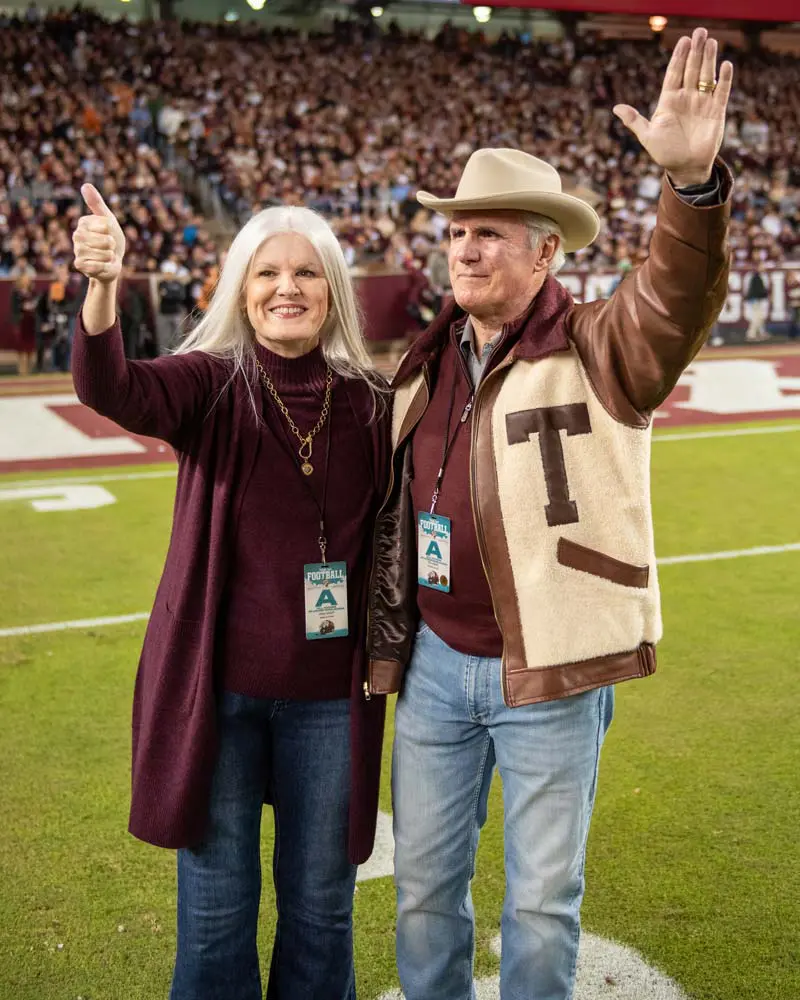
“If the E. King Gill Award gives us the chance to tell the story of why athletics is important, not just as a money maker but to our very culture, then that's something we ought to do.”
That day's matchup with Centre College left the Aggies battered. With his roster depleting, head coach Dana X. Bible remembered Gill in the stands and signaled for him to come down, suit up and be ready to play.
And so, E. King Gill assumed the role of the 12th Man, igniting a tradition and legacy that lives on to this day. Though he never entered the game, Gill remained on standby for his team — an act that continues to inspire and unite Aggies everywhere.
“But I've never thought that the 12th Man really belonged to a personality,” Gill said to the crowd. “It belongs to the A&M student body. And every one of you can be a 12th Man if you stand up. Stand up for what's right and be ready to serve.”
Less widely known is Gill's remarkable life of service beyond football. He earned a medical degree from Baylor College of Medicine, served as an Air Force colonel and surgeon in World War II and established a successful ear, eye, nose and throat practice in Corpus Christi.
As requested, Gill told the Aggie Muster crowd how being known as the 12th Man had shaped his life.
“I think it's affected me this way: I see more young people that come by to see me. I think I've been a little better man and doctor. And I think it can do a lot for you.”
More than anything, Gill embodied a lifelong commitment to selfless service.
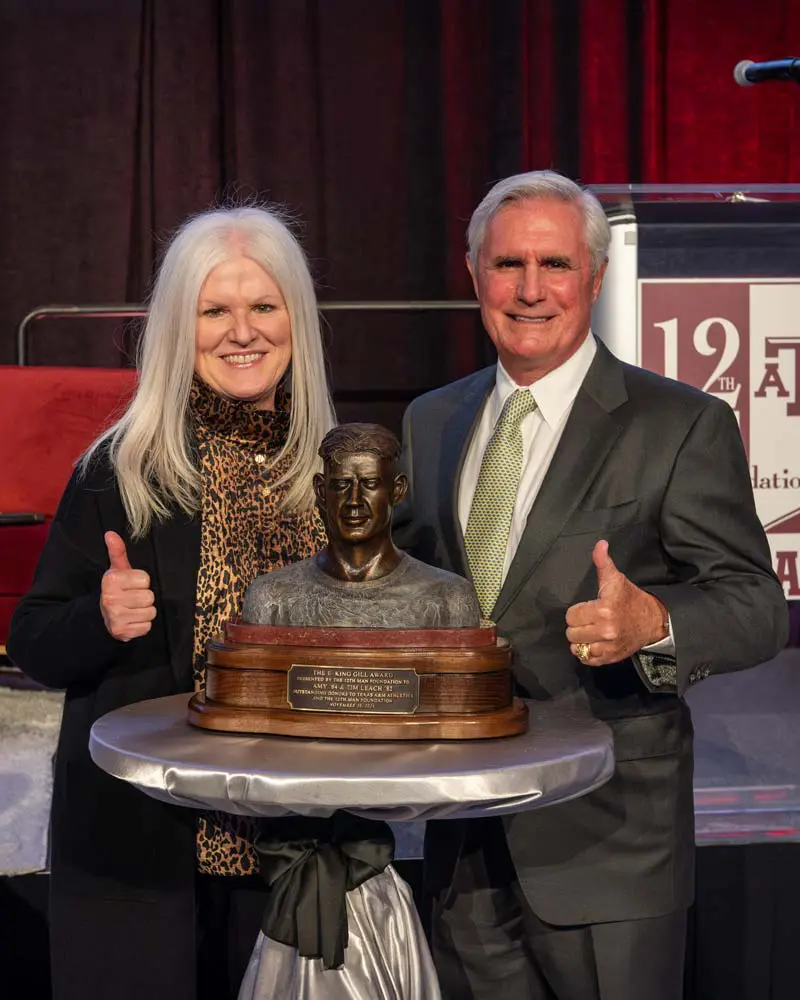
Over 100 years later, that same spirit shines through the 2024 E. King Gill Award recipients — Amy '84 and Tim Leach '82.
Like Gill, the Leaches have faithfully served their community and beloved alma mater with the utmost humility and generosity.
THE STARTING BLOCKS
Growing up in Houston, Tim Leach first stepped foot onto Texas A&M's campus as a high school junior while competing in a regional track meet at Kyle Field. "
It was a beautiful place, and the creamery was right across the street from the track," Tim recalled. "No one told me that you shouldn't compete in a track meet and drink milkshakes at the same time."
After several more track meet trips to Aggieland, Tim learned that A&M had a prominent engineering school — a detail that piqued his interest. As the son of a Shell engineer, and with the university's proximity to home, Tim's choice for college came easily.
Once accepted, he was off to the races to become an Aggie engineer.
"They were giving out scholarships in petroleum engineering," Tim recalled. "I think I signed up for mechanical engineering originally, but I switched to petroleum. I lived in Davis-Gary Hall all four years."
Two years after Tim began his journey at Texas A&M, his high school sweetheart Amy joined him in Aggieland. Together, they attended countless Aggie sporting events, tackled their coursework and made connections that evolved into lifelong friendships.
"The engineering school made it so hard that it'd be nearly impossible to get through just on your own," Tim said. "We had 10 to 15 people who studied together."
The group reunites each year around a home football game.
"Everyone looks forward to that reunion," Amy added.
Those college days gave Amy and Tim more than just lasting connections — they also sparked a desire to spend the rest of their lives together.
While working as a student teaching assistant, Tim saved enough extra money to treat Amy to a special evening of steak and dancing — a night that ended with Tim asking a very important question.
"We got engaged at the Fort Shiloh Steakhouse," Tim said with a broad smile. "That was after we sat underneath the Century Tree. The rumor was you had to be careful who you went under that oak tree with because you would get married to them."
For Tim, he never had a doubt.
"I don't think it was the Century Tree that convinced me to ask her," he admitted. "It was the wrangler jeans and the white blouse she had on."
HITTING STRIDE
In May of 1982, Amy and Tim married and moved to Midland, Texas where Tim accepted a job with Midland National Bank in their energy lending department. The couple quickly established roots and launched their careers. Simultaneously, Tim attended night school to earn his MBA.
As they adjusted to their new life out west, the two discovered what made the Tall City feel like home — its people.
"You just don't have the community like it in larger places," Amy said. "We made friends who we've grown up with. We've raised our kids together and gone to church together. It's a really unique and special place to be."
"The oil business in Midland is really open if you're working hard," Tim added. "Even if you're not from there, they're rooting for you. All you have to do is show up, work hard and be honest, and people will try to help you."
A well-known local who helped Tim get his own start was a man named R.A. "Murray" Fasken '38. As chairman of Midland National Bank, Fasken hired Tim and quickly became a trusted mentor for the young professional.
"He was a great, funny and legendary guy," Tim said.
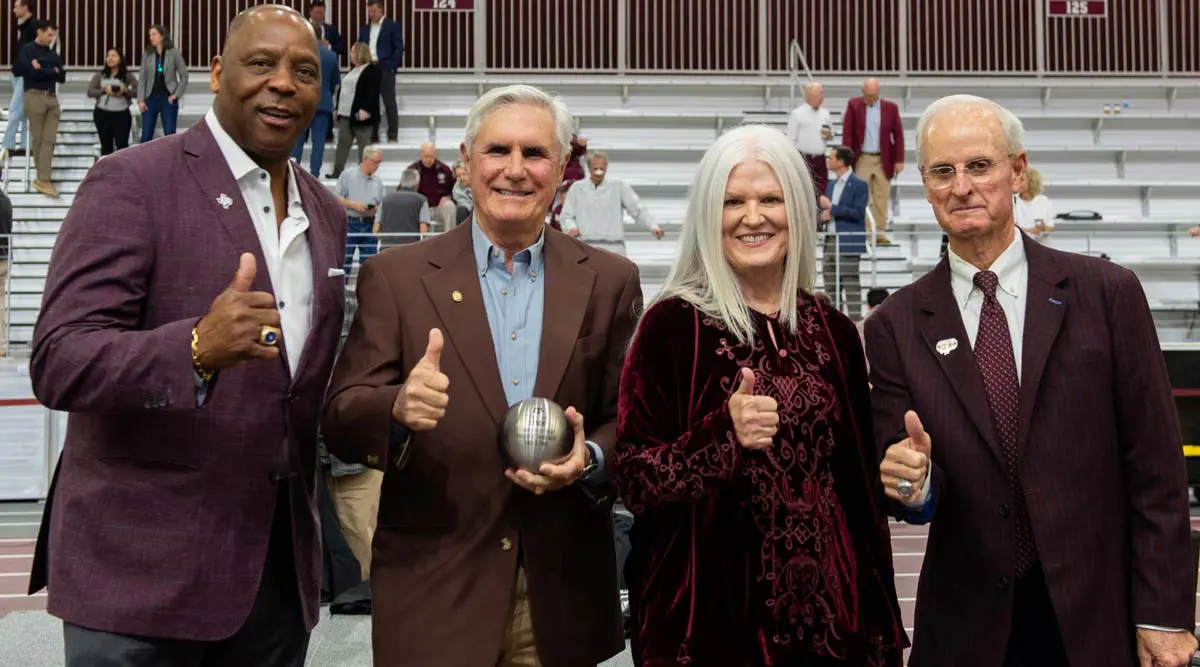
Fasken was a devoted philanthropist and among A&M's earliest benefactors, quietly supporting both academics and athletics. Decades later, he would be honored by Amy and Tim through their generous contribution toward the construction of the R.A. 'Murray' Fasken '38 Indoor Track & Field, which debuted as the new home of Texas A&M's indoor track & field teams in 2024.
"He led and supported programs in such a way that many Aggies have never heard of his legacy," Tim said.
Fasken's humble support is one of many stories the Leaches have commemorated through their own philanthropy. Their commitment to paying it forward underscores the value of looking back to recognize those who paved the way.
"The whole notion of standing ready still lives with us today," Tim said. "So, I think it's important to remember where we all come from and who we all come from."
"I think stories are so important, and I'd rather tell other people's stories," Amy added. "Honoring other Aggies, who have gone before us."
TAKING THE BATON
In 1989, Tim accepted an opportunity with a startup oil and gas company that would later become Pioneer Natural Resources. That move laid the foundation for his co-founding of Concho Resources in 1997, an independent oil and natural gas company focused primarily in the Permian Basin. Concho merged with ConocoPhillips in 2021, where Tim continues to serve on the board today.
Throughout those years, Amy worked, managed their household and helped raise their two Aggie sons, William '12 and Patrick '14. As the energy industry ebbed and flowed, she provided steady guidance and strength for their family.
“Home was a place of peace and refuge,” Tim said. “Her biggest contribution was making a stable world where, no matter what the ups and downs were in the oil and gas industry, you knew if you went home, it was a peaceful place.”
While the responsibilities of work and family distanced their ties to Aggieland, an unexpected conversation inspired the Leaches to reengage with the university.
“Claytie Williams called me up and said, 'Hey Leach, my generation is passing away, and your generation is slouching. You need to pick it up, son,'” Tim said with a chuckle. “He just told me that I needed to take the baton because it was my turn.”
Not only did the Leaches take the baton of support — they carried it across the finish line and into the next race.
Beyond the Fasken Indoor Track & Field, Amy and Tim have left an indelible mark across Texas A&M's campus, providing lead gifts for the historic redevelopment of Kyle Field and E.B. Cushing Stadium, supporting the Memorial Student Center, the Zachry Engineering Education Complex, the Leach Teaching Gardens, Aggie Park, the Harold Vance Department of Petroleum Engineering and the Randy Sims '61 Endowed Chair for City and County Governance at The Bush School of Government and Public Service.
“They are special, and they are committed to Texas A&M and the things we do,” said Jacob Green '80, 12th Man Foundation vice president of principal gifts. “Their passion for A&M is unbelievable.”
The Leaches' support through leadership has been just as impactful, serving as co-chairs of the university's $4 billion Lead by Example campaign from 2015 to 2020. Tim also served on the Texas A&M University System Board of Regents from 2017 to 2023, including two years as chair. In 2020, he was recognized as a Distinguished Alumnus by The Association of Former Students.
“It is a privilege recognizing Amy and Tim as recipients of the E. King Gill Award,” said Travis Dabney '96, 12th Man Foundation president & CEO. “The Leaches are caring, honest and generous Aggies. Texas A&M is a better institution because of them.”
CARRYING THE LEGACY
When closing his Aggie Muster speech, E. King Gill left one final charge with the crowd.
“The A&M Muster is a thing that touches each one of us, and these traditions will grow more valuable till you get older,” Gill said. “And memory is a very valuable thing when you reach 60. So, it's my wish, here today, that you preserve these traditions. It's made me a better Aggie, and it will make you a better Aggie.”
As for the Leaches, they share the same desire and affections of their award's namesake.
“The 12th Man and athletics at A&M have really affected our lives,” Tim said. “We want to win, but winning is not everything. I think remembering the long traditions we have and the people who went before us is extremely important. If the E. King Gill Award gives us a chance to tell the story of why athletics is important, not just as a money maker but to our very culture, then that's something we ought to do.”
Through the example of extraordinary Aggies like Amy and Tim Leach, the 12th Man legacy endures, inspiring others to stand ready and answer the call.