David Coolidge ’87
2025 E. King Gill Award Honoree
By Brian Davis ’01
Nearly 40 years after first stepping onto Kyle Field as a member of the 12th Man Kickoff Team, David Coolidge ’87 found himself at the center of a moment he never expected.
As the Fightin’ Texas Aggie Band was forming at the north end of Kyle Field during halftime of Texas A&M’s game against Utah State on Sept. 6, 2025, the spotlight in Coolidge’s suite turned to him. Surrounded by family and friends, he learned he had been named the 2025 recipient of the E. King Gill Award.
The emotion was immediate.
“You could see the tears in his eyes,” said Jacob Green ’80, 12th Man Foundation vice president of principal gifts. “He had no idea. It was good to see him show that emotion, just being honored and being loved by so many people.”
For Coolidge, the moment was overwhelming.
“I was kind of in awe,” he said. “I think it’s a great honor. I’m still not sure I deserved it.”
Then he paused, reflecting on what the recognition meant.
“It was really like a culmination of a lifetime of caring about A&M,” Coolidge said. “I’ve been involved as a player, as a donor and as an adult. I recently told somebody after a tough loss, ‘I wish I didn’t care as much.’ He said, ‘That’s never going to happen. You can’t turn that off.’ And he’s right.”
For those who know him best, that unwavering commitment is exactly why the honor fits. Named for the original 12th Man, the E. King Gill Award recognizes individuals whose service and generosity embody the spirit of standing ready for Texas A&M — something Coolidge has done his entire life.
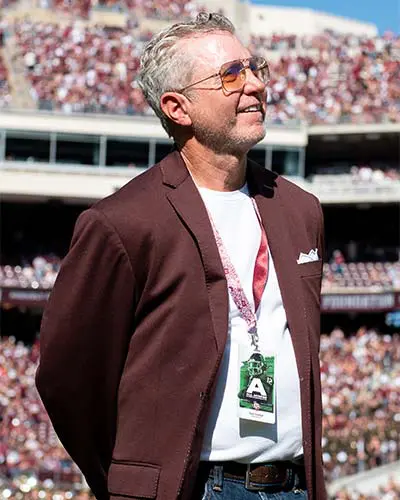
“I remember thinking, 'What I want to do when I grow up is play on that field.' And it happened.”
“Few individuals have demonstrated the lifelong dedication and selfless commitment that David has given to Texas A&M,” said 12th Man Foundation President & CEO Travis Dabney ’96. “He has consistently answered the call and is an exceptionally deserving recipient of the E. King Gill Award.”
MAROON-BLOODED
Coolidge’s connection to Texas A&M began long before he became a student, a letterman or a donor.
His father, John Coolidge ’52, was an Aggie. His three older siblings attended Texas A&M. Maroon was not a preference in the Coolidge family — it was part of their identity.
“A&M was just sort of part of the fabric of who our family was,” Coolidge said.
Growing up in Houston, he made regular trips to Aggieland for football games in the 1970s. His earliest memories remain vivid: walking past the dorms, seeing families tossing footballs, watching the yell leaders and standing with the 12th Man as the Aggie Band marched onto Kyle Field.
Even then, the scene stirred something in him.
“I remember thinking, ‘What I want to do when I grow up is play on that field,’” Coolidge said. “And it happened.”
His love for Aggie Football was not casual. On Saturdays when the family was not traveling to College Station, Coolidge made sure his chores were finished before kickoff. He read Dave Campbell’s Texas Football and Sports Illustrated. He followed recruiting long before online message boards and social media made that a pastime. He knew the names, hometowns and reputations of players before he ever shared a practice field with them.
His siblings liked Texas A&M, but Coolidge admits he was different.
“I was the only one that got the disease of following sports too closely,” he said. “Nobody was as silly about it in my family as I was.”
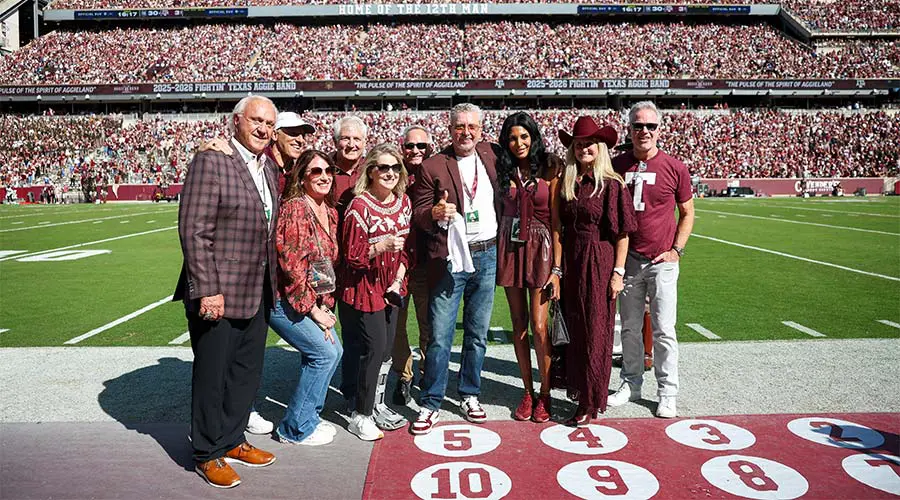
That passion followed him to Westbury High School, where Coolidge became an all-district and all-city safety. Other schools showed interest, and he briefly considered opportunities to continue playing elsewhere. But his path always seemed to point back to Aggieland.
“I was pretty much destined,” he said. “There are pictures of me wearing A&M shirts when I was young. I’ve just been wearing A&M stuff my whole life.”
When he arrived at Texas A&M, he did so in the simplest way imaginable. He drove to College Station in his father’s old Chevrolet Impala with a duffel bag of clothes and little else. He moved into Cain Hall, met new teammates and began chasing a dream that had lived in him since childhood.
He was nervous, but not uncertain.
“I remember thinking, ‘Man, I’m happy to be here,’” Coolidge said. “I bought in before I got here, but I certainly bought in when I got here.”
STANDING READY
Coolidge did not come to Texas A&M hoping to be a member of the 12th Man Kickoff Team. He came to play defensive back. He wanted to compete, earn his place and help the Aggies win.
The path was not easy.
As a young walk-on, Coolidge believed he had to outwork everyone to close the gap with scholarship players. During two-a-days, after grueling practices in an era with fewer water breaks than there are today, he went back to Kyle Field at night to run extra sprints.
There were no gates then. Coolidge would walk through the tunnel into the dark stadium and begin running the length of the field.
One night, he heard someone else coming.
A figure nearly collided with him in the darkness. It was Johnny Holland, who would go on to become one of the greatest linebackers in Texas A&M history.
“I asked, ‘What are you doing out here?’” Coolidge recalled. “He said, ‘I’ve got to get my game right.’”
Years later, Coolidge laughs at the memory. He realizes that running extra sprints during two-a-days may not have been the wisest way to preserve energy. But the instinct behind it revealed who he was — a young player willing to do whatever he thought was necessary to earn the uniform.
In 1984, Coolidge tried out for the 12th Man Kickoff Team, but when the two-deep roster was posted after two-a-days, his name was not listed. He was devastated.
Roy Kokemoor, the 12th Man Kickoff Team coach that season, pulled him aside and urged him not to quit, explaining that while he might not play that year, he had a real chance to earn a starting role the following season.
He was right.
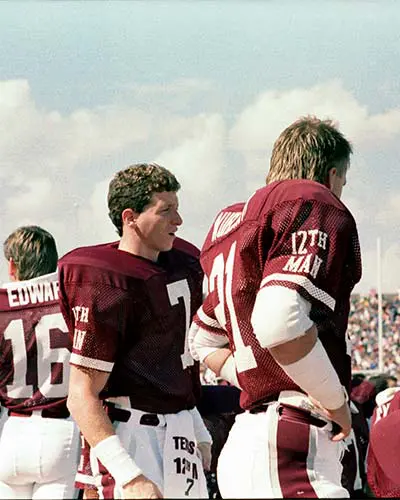
In 1985, competing against roughly 200 walk-ons, Coolidge made the team.
The Aggies opened that season on the road against Alabama in Birmingham. The 12th Man Kickoff Team was not scheduled to make the trip, but Coolidge and teammates Mark Wurzbach ’87 and Mike Tolleson ’87 drove anyway. When an assistant coach learned they were coming, arrangements were made for their equipment to travel with the team.
They stayed in a modest hotel away from the team, showed up early, rode the bus, suited up and stood on the sideline.
A week later, in Texas A&M’s home opener against Northeast Louisiana on Sept. 21, 1985, Coolidge ran down on the first kickoff of his Kyle Field career. The returner cut back. Coolidge wrapped him up and brought him down.
“I can see it in my mind’s eye like it was yesterday,” he said.
His teammates piled on top of him in celebration. For the boy who had once dreamed of playing on that field, it was a surreal moment. But at the time, Coolidge did not see it as a storybook ending.
“I felt like I had a job to do, and I did it,” he said. “So, I had to go do it some more.”
Coolidge lettered in 1986 as part of a championship team that beat Texas, 16-3, on a rainy Thanksgiving night in Austin to clinch a second consecutive Southwest Conference title. He still remembers the celebration in the Longhorns’ locker room, the tears from teammates and the shared feeling that they had accomplished something special together.
“To be a part of that program at that point, that was really special,” Coolidge said. “Anytime you’re part of something bigger than yourself and it turns out to be somewhat unique, you feel very humbled.”
From Sherrill’s perspective, the 12th Man Kickoff Team was a group built on toughness and unwavering commitment.
“Their practice wasn’t an hour and 45 minutes,” Sherrill said. “Their practice was two hours and 45 minutes because they would go out 30 minutes before practice and stay 30 minutes after.”
The respect they earned lasted far beyond their playing days.
Former scholarship teammates have told Coolidge how the 12th Man Kickoff Team made them better because of how hard they worked.
“To earn that respect means a lot,” he said. “When you come out of college, there are labels. But you get through that, and there’s no hierarchy in our friendship. There are no labels. You’re just friends.”
Those friendships and relationships remain among the greatest gifts of his Texas A&M experience.
DREAMING BIG
Although Coolidge’s time on the football field was cut short due to an ACL injury in the summer prior to his senior season, the experience gave him more than memories. It gave him confidence.
“I think anytime you set out to do something in life and you accomplish it, it gives you confidence for the next thing,” he said. “It kind of taught me it’s OK to dream big. Don’t settle for less. Don’t be afraid to fail. Go for it.”
After earning his degree in industrial distribution, Coolidge accepted a job in California. Less than a year later, homesick and facing a transfer he did not want, he returned to Texas without a job.
He printed résumés and walked building to building in downtown Houston. At one stop, a receptionist noticed his Southwest Conference championship ring and asked what it was. When Coolidge told her it was from Texas A&M, she took the ring to show an Aggie in the office.
Ten minutes later, she returned with the ring — and a lead.
A few days later, Coolidge had an interview. Soon, he had a job in the natural gas industry.
“If I didn’t have that Southwest Conference championship ring on, I wonder,” Coolidge said. “My life could be completely different.”
That opportunity launched a career that eventually led Coolidge to found Velite Capital Management in 2006, a natural gas commodities fund. As his professional success grew, he found himself applying many of the same lessons he had learned through football: accountability, standards, culture, teamwork and process.
“Everything that you learn here, I tried to replicate in my own way at my company,” he said. “Building a team and a culture and developing a process can give you a chance at success. I felt like I took those values and used them throughout my whole career.”
Along the way, Coolidge also built a life centered on family. He is the proud father of four children — Catherine ’19, Madeline, Wilson and Coleman — and now a proud grandfather as well. His passion for Texas A&M has remained a constant throughout their lives as well.
“I think they see my loyalty and commitment to A&M, and that means something to them,” Coolidge said. “In the same way I adopted the Aggies because of my dad, they’ve grown up around that passion, too. Even though they all took different paths, I think they understand what A&M has meant to me.”
A LEGACY OF IMPACT
Coolidge’s giving in support of Texas A&M began modestly, driven by gratitude for what the university had meant to him. Over time, his engagement grew through relationships with former teammates and the 12th Man Foundation.
He often jokes that he finally received the call from Texas A&M he had dreamed about as a high school football player.
“My goal when I was in high school was to get recruited by A&M,” Coolidge said. “I wanted a phone call from A&M saying, ‘We need you.’ I was thinking it would be the football staff, not the 12th Man Foundation. So be careful what you ask for.”
What began as a desire to give back eventually led to transformational support.
Coolidge’s generous contributions helped fund the Coolidge Outdoor Practice Fields, the historic redevelopment of Kyle Field, the Davis Player Development Center and, most recently, the Coolidge Football Performance Center. His $15 million lead gift to the Centennial Campaign helped make possible the 132,000-square-foot facility now standing near the southwest corner of Kyle Field as college athletics’ largest indoor football practice facility.
Green said there was no hesitation from Coolidge when the opportunity arose.
“He played the game, and he knows what type of facilities need to be out there day in and day out to help our student-athletes,” Green said. “His generosity has given us a steppingstone to continue to be great on the football field.”
Coolidge’s commitment has also extended through leadership and service. He served on the 12th Man Foundation Board of Trustees from 2020 to 2023, and in 2021, he was inducted into the Texas A&M Athletics Hall of Honor.
Larry Hodges ’88, one of Coolidge’s closest lifelong friends, has watched that generosity grow from the beginning. The two first met in August 1974 as boys playing peewee football. They played together through high school, cut grass across southwest Houston during the summers and remained close through every stage of life.
To Hodges, the resources may have changed, but the person has not.
“The amazing guy he is now is the same guy who was then,” Hodges said. “Nothing has changed. Whether we were getting in a station wagon, driving across Houston to mow a lawn for $8, or whether he’s making a lead gift for a building at Texas A&M, he’s the same person. That’s what people love about him.”
Hodges also sees Coolidge as someone who helped inspire his generation of Aggies to think bigger about their impact.
“We all bought season tickets, and we all made donations,” Hodges said. “But he was probably one of the first of our generation to say, ‘I’m going to make an impact.’”
For Coolidge, that impact has never been about recognition. In fact, he initially struggled with the idea of having his name on facilities because he worried it might seem like he was calling attention to himself. Friends and former teammates encouraged him to see it differently — if he wanted to give back and Texas A&M wanted to honor that gift, he should be proud to help.
Still, those closest to him say his most meaningful acts are often the ones few people see.
“Dave does an awful lot that no one knows, and he doesn’t want people to know,” Sherrill said.
That includes helping former teammates and others in need, offering guidance to younger Aggies and supporting causes that matter to him. Coolidge describes himself as a cheerful giver, but only when the cause genuinely speaks to him.
“I feel super blessed,” Coolidge said. “I feel like I have way more than I deserve. Because of where I’m at, it’s incumbent upon me to give back.”
ALL IN
The more Coolidge reflects on his life, the more he sees Texas A&M woven throughout it.
His childhood dreams led him to Kyle Field. His walk-on experience gave him confidence. His championship ring helped open a professional door. His success gave him the ability to create opportunities for future student-athletes. His friendships continue to connect him to the people and values that shaped him.
“My story is really all interwoven,” Coolidge said. “It all goes right back to here.”
That is why the E. King Gill Award means so much. It recognizes more than a gift. It recognizes readiness. It recognizes loyalty. It recognizes a life lived in response to what Texas A&M gave him.
Sherrill describes Coolidge as private, quiet and uninterested in attention — precisely the kind of person the award is meant to honor.
“You’re not going to see him trying to get attention,” Sherrill said. “And that’s basically what the E. King Gill Award is — standing tall, ready to help.”
When Coolidge thinks about legacy, he does not mention facilities first. He does not talk about dollars. He hopes people will remember something simpler.
“I hope they would say he was all in,” Coolidge said. “If they describe me as a donor, then I failed. I hope they would say he was a good person, treated everybody with respect and was all in.”
From a boy in the stands dreaming of playing on Kyle Field, to a walk-on sprinting through the darkness, to a 12th Man Kickoff Team member racing downfield, to a father, grandfather, leader and supporter helping build the future of Aggie Athletics, Coolidge has spent a lifetime answering the same call.