More Than the Game
A lifelong passion for athletics and education continues through Bowen and Karin Loftin’s support of Aggie student-athletes
By Camryn Garner ’21
Athletics have long been woven into the lives of Bowen ’71 and Karin Loftin.
Sports have shaped friendships, strengthened family bonds and created opportunities that have influenced the course of their lives for decades. Today, that lifelong passion continues through their support of Texas A&M student-athletes and the programs that help them succeed both in competition and in life.
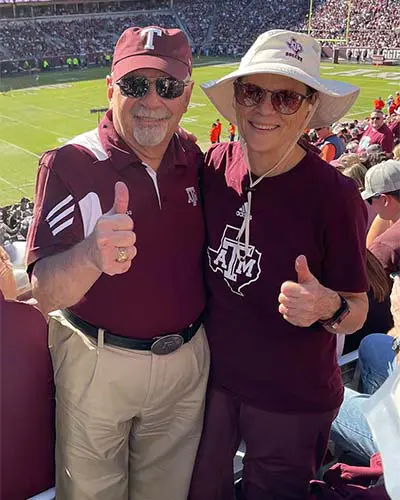
It would be difficult to attend many Texas A&M sporting events without eventually spotting the Loftins. Bowen and Karin are fixtures around Aggieland, regularly supporting Aggie student-athletes across A&M’s campus. Although the couple became deeply immersed in Aggie Athletics after Bowen was appointed the university’s president in 2010, their passion for sports had already shaped much of their lives long before arriving in Aggieland.
Growing up in Navasota, Texas, Bowen developed an early love for baseball. Though he laughs at the idea of calling himself a standout athlete, sports still played a meaningful role throughout his childhood.
“I’m not a natural athlete like Karin,” Bowen said with a laugh. “She was always the real athlete.”
Bowen played baseball throughout his childhood and became known as a switch hitter after a Little League coach encouraged him to bat left-handed against predominantly right-handed pitchers. Decades later, baseball remains his favorite sport.
While Bowen’s athletic experiences centered around small-town Texas sports, Karin’s childhood looked a little different. Raised in Germany, athletics were an important part of daily life from an early age. She participated in gymnastics, swimming and soccer while growing up and quickly developed a deep appreciation for the value sports can have in a young person’s life.
“The whole idea is you commit to the success of the student-athlete, not just as an athlete, but as a student and as a human being.”
“Sports were just a really important part of growing up,” Karin said. “It was essential in our development.”
After immigrating to the United States in 1959, Karin was surprised by the limited opportunities available for girls in athletics at the time. Still, her passion for sports never faded. She attended Oakland University in Rochester, Michigan, where she spent time as a collegiate swimmer during her freshman year before ultimately focusing on academics.
Bowen and Karin married in the fall of 1972, and years later, their shared love of athletics became a central part of raising their family.

Their daughter, Elisabeth, was born in 1976, followed by their son, Ben, in 1979. From an early age, both children were heavily involved in sports.
Karin coached her children’s soccer, basketball and Little League teams throughout their childhood years. Bowen even recalled that Karin became the first female Little League baseball coach in their Bay Area community near Houston at the time.
What began as coaching her own children evolved into years of coaching youth athletics throughout the community, particularly girls club soccer programs.
“She really encouraged the girls to have fun and play hard,” Bowen said. “We’ve run across some of those girls much later in life, and they still talk about Coach Karin.”
Athletics remained a major part of the Loftin family as their children grew older. Elisabeth went on to play collegiate soccer at Martin Luther College in Minnesota, while Ben became a standout multi-sport athlete who eventually won a Wisconsin state wrestling championship in high school.
Those experiences only deepened the Loftins’ appreciation for the role athletics can play in shaping character, discipline and personal growth.
That perspective continued throughout Bowen’s leadership at Texas A&M. As the university’s 24th president, Bowen helped guide Texas A&M through a transformative period that included the university’s transition into the Southeastern Conference in 2012, a move that elevated the national profile of Aggie Athletics and ushered in a new era for the university.
During that time, the Loftins became even more immersed in Aggie Athletics and developed close relationships wit h coaches, administrators and student-athletes across numerous programs.
One of their favorite memories during Bowen’s presidency came in 2011 when Texas A&M Women’s Basketball captured the national championship under head coach Gary Blair.
The Loftins were in Indianapolis as the Aggies defeated Notre Dame to secure the first national title in program history. The postgame celebration became especially memorable when confetti in Notre Dame’s colors began falling onto the court, a reminder that few expected Texas A&M to win the title.
Bowen recalled some of the Aggie players being disappointed by the mix-up before reminding them of what truly mattered.
“I told them, ‘We have the trophy. Don’t worry about the color of the confetti,’” Bowen said with a chuckle.
Over time, the Loftins’ passion for athletics evolved into a strong commitment to supporting student-athletes through philanthropy. Among their contributions to Texas A&M Athletics are two endowments established through the 12th Man Foundation.
The Mike Slive Memorial Endowment honors former SEC Commissioner Mike Slive, whom Bowen described as both a close friend and a passionate advocate for student-athletes throughout his career in collegiate athletics.

Bowen said Slive, a former collegiate lacrosse player at Dartmouth, strongly believed student-athletes should be supported academically just as intentionally as they were athletically.
“Mike was all about trying to make people understand that it wasn’t just the sport,” Bowen said. “It was the whole person.”
That philosophy of developing the whole student-athlete deeply resonated with the Loftins and continues to shape their approach to supporting Texas A&M Athletics today. Through the endowment, the Loftins hope to honor Slive’s legacy for generations to come while continuing to provide resources that support the academic success and personal development of Aggie student-athletes beyond competition.
The Loftin ’71 Baseball Endowment reflects Bowen’s lifelong love for the sport and his desire to provide meaningful support for the Aggie Baseball program. Through the Baseball Excellence Fund, the endowment provides flexible resources to help address the program’s evolving needs.
“It’s hard to prescribe what’s necessary to make a team work well,” Bowen said. “I wanted to give the team discretionary funding they could use each year to help support baseball excellence here at Texas A&M.”
For the Loftins, supporting Texas A&M student-athletes ultimately goes far beyond wins and losses. Their experiences as athletes, coaches, parents and supporters have reinforced their belief in the lifelong value athletics can provide.
“Bowen and Karin are incredibly thoughtful and intentional in the way they support Texas A&M student-athletes,” said Jacob Green ’80, vice president of principal gifts at the 12th Man Foundation. “For them, it’s always about helping young people succeed.”
During his A&M presidency, Bowen recalled often taking an extra moment to personally recognize graduating student-athletes as they crossed the commencement stage, thanking them not only for their academic accomplishments, but also for the impact they made representing Texas A&M through athletics.
“Being a Division I athlete at the college level is a full-time job all by itself,” Bowen said. “Being a good student here is also a full-time job. These kids are doing two full-time jobs, and I always wanted to thank them for what they did for Texas A&M University.”
That belief continues to shape the Loftins’ support of Texas A&M Athletics today. Through their philanthropy and involvement with the 12th Man Foundation, they hope to help student-athletes grow not only as competitors, but as people prepared for success long after their playing careers come to an end.
“The whole idea,” Bowen said, “is you commit to the success of the student-athlete, not just as an athlete, but as a student and as a human being.”